

Core Residents – Birds & Nests at Reddings Retreat
Core Residents are the year‑round companions of Reddings Retreat. These are the birds you’re most likely to see in the gardens, hedgerows, woodlands, and skies above the Wye Valley at any time of year. Their nests are often close to home — tucked into hedges, trees, or even buildings — making them familiar neighbours for guests.


📸 Photos
Photos are a work in progress and will be added as and when they are received from guests and local photographers
Thrushes
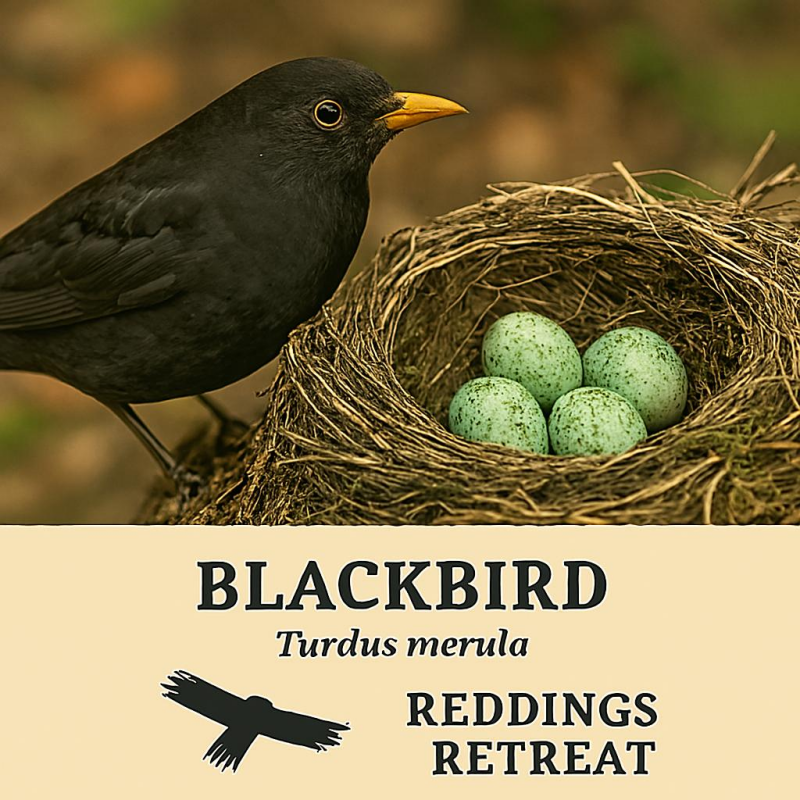
Blackbird (Turdus merula / Mwyalchen ddu)
-
Description: Males glossy black with yellow beak; females brown with speckled breasts.
-
Size: 24–25 cm.
-
Where it lives: Gardens, hedgerows, woodland edges.
-
Nest: Neat cup of grass and mud in hedges or shrubs.
-
Spotting Tip: Hops on lawns, flicking leaves for worms.
-
Photo Tip: Evening light highlights males’ yellow beaks.
-
Rarity: Very Common.
-
Folklore: Dawn chorus icon, linked with storytelling.
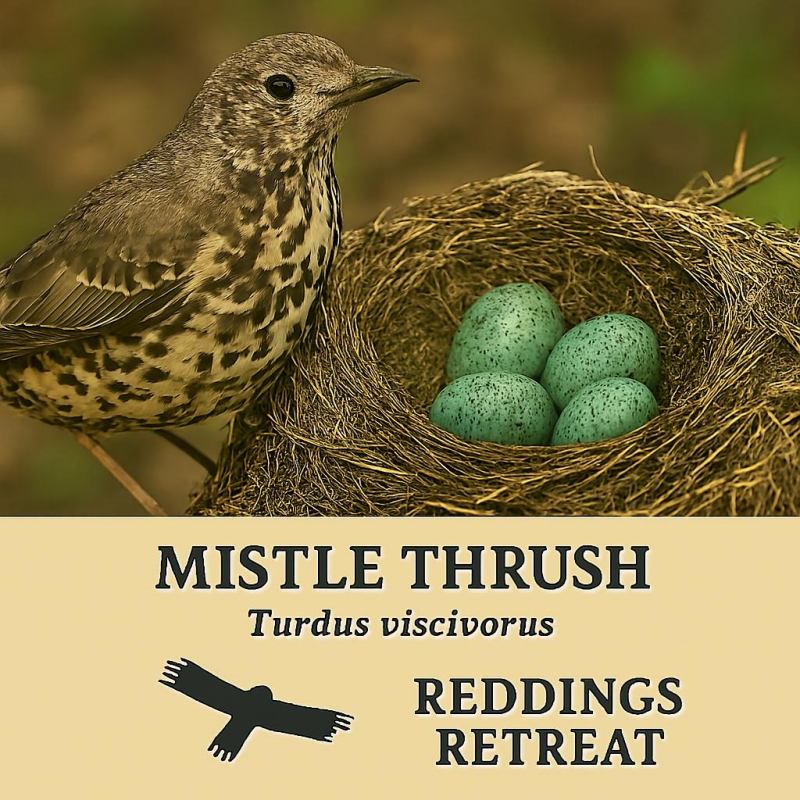
Mistle Thrush (Turdus viscivorus / Dryw eurben)
-
Description: Large thrush, grey‑brown with bold spots.
-
Size: 27–28 cm.
-
Where it lives: Fields, parkland, woodland edges.
-
Nest: Bulky cup high in trees.
-
Spotting Tip: Upright stance, rattling call.
-
Photo Tip: Open lawns give clear silhouettes.
-
Rarity: Occasional.
-
Folklore: “Storm cock,” sings in bad weather.
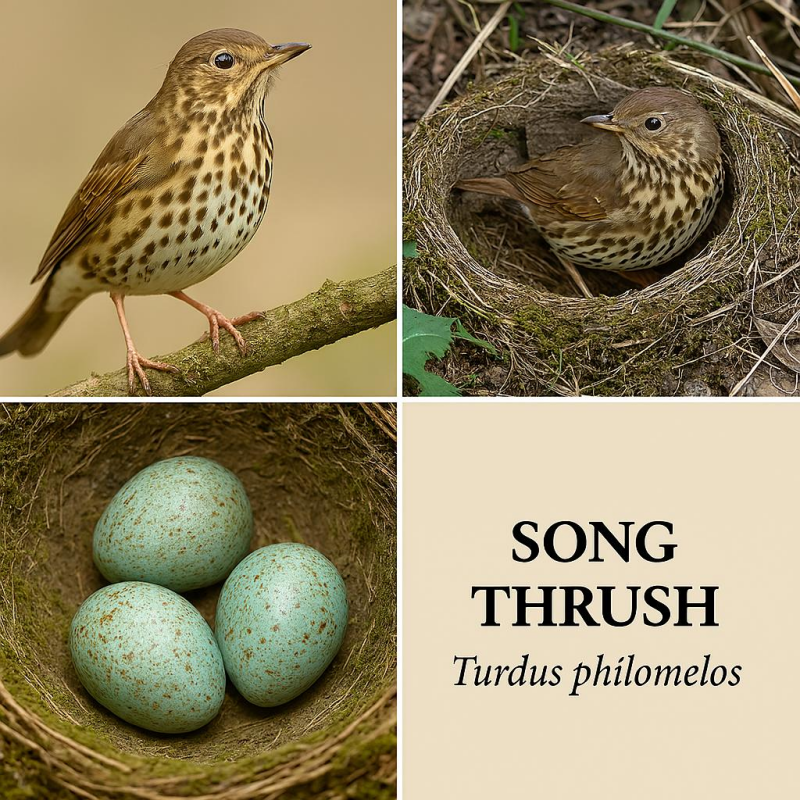
Song Thrush (Turdus philomelos / Dryw eurben bach)
-
Description: Warm brown, spotted breast, smaller than blackbird.
-
Size: 21–23 cm.
-
Where it lives: Gardens, hedgerows, woodland.
-
Nest: Cup of grass and mud, lined with smooth mud.
-
Spotting Tip: Repeats song phrases.
-
Photo Tip: Fence posts at dawn give sharp shots.
-
Rarity: Declining / Conservation Concern.
-
Folklore: Symbol of joy and renewal.
Familiar Garden Birds
Robin (Erithacus rubecula / Robin goch)
-
Description: Small, round, orange‑red breast and face.
-
Size: 12–14 cm.
-
Where it lives: Gardens, hedgerows, woodland edges.
-
Nest: Cup low to ground in banks, sheds, ivy.
-
Spotting Tip: Bold, often near people.
-
Photo Tip: Early light enhances red breast.
-
Rarity: Very Common.
-
Folklore: Symbol of renewal; linked with Christmas.
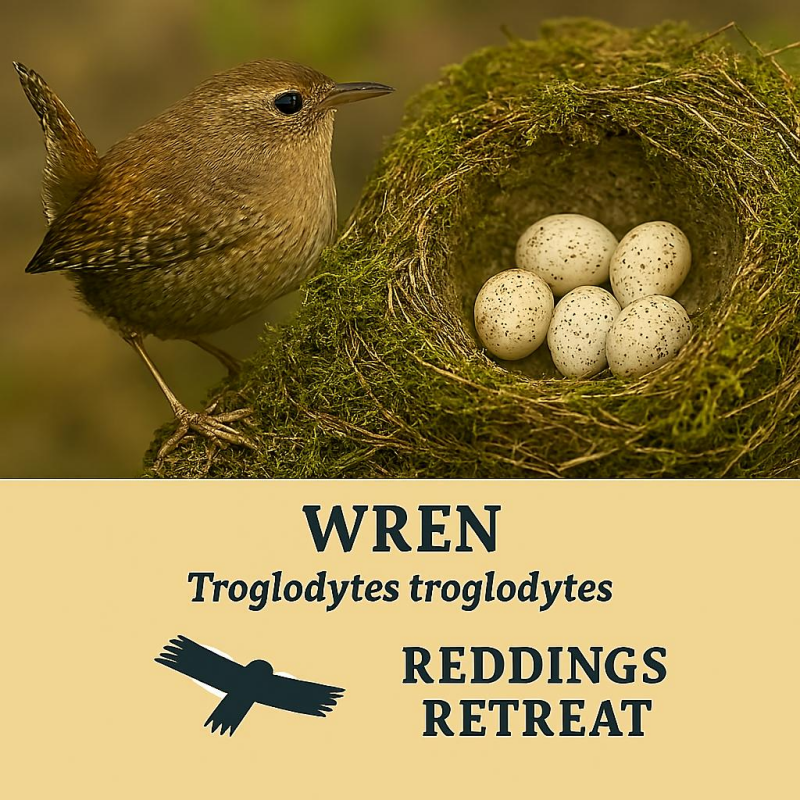
Wren (Troglodytes troglodytes / Dryw)
-
Description: Tiny, brown, cocked tail, loud song.
-
Size: 9–10 cm.
-
Where it lives: Dense undergrowth, ivy, stone walls.
-
Nest: Dome of moss and leaves in crevices.
-
Spotting Tip: Explosive song betrays presence.
-
Photo Tip: Use burst mode; quick movements.
-
Rarity: Very Common.
-
Folklore: “King of birds” in Celtic legend.
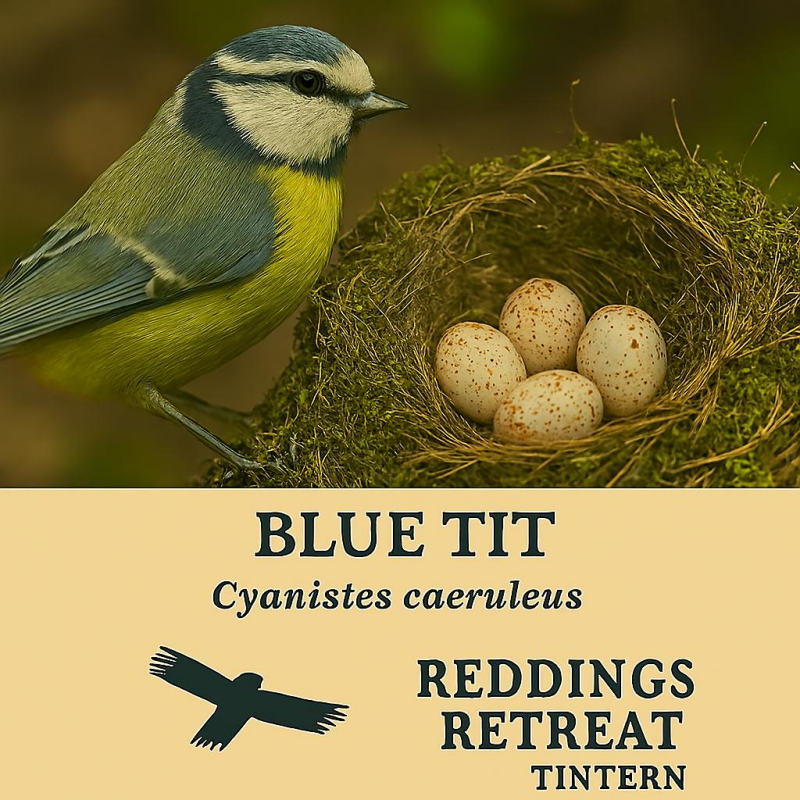
Blue Tit (Cyanistes caeruleus / Titw tomos las)
-
Description: Tiny, blue crown, wings, tail, yellow belly.
-
Size: 11–12 cm.
-
Where it lives: Gardens, hedgerows, woodland edges.
-
Nest: Tree holes or nest boxes, lined with moss and wool.
-
Spotting Tip: Hangs upside‑down on feeders.
-
Photo Tip: Use fast shutter at feeders.
-
Rarity: Very Common.
-
Folklore: Cheerful garden spirit.
Coal Tit (Periparus ater / Titw coed)
-
Description: Small, greyish, white nape patch.
-
Size: 10–11 cm.
-
Where it lives: Conifer woodland, gardens.
-
Nest: Holes in conifers or crevices.
-
Spotting Tip: Quick feeder visits.
-
Photo Tip: Pale nape patch shows in conifers.
-
Rarity: Common.
-
Folklore: Symbol of resilience.
Great Tit (Parus major / Titw mawr)
-
Description: Largest tit, black head, yellow belly with stripe.
-
Size: 14 cm.
-
Where it lives: Gardens, parks, woodland.
-
Nest: Tree holes or nest boxes.
-
Spotting Tip: “Teacher‑teacher” call.
-
Photo Tip: Side‑on shows chest stripe.
-
Rarity: Very Common.
-
Folklore: Boldness and adaptability.
Long‑tailed Tit (Aegithalos caudatus / Titw penwaig)
-
Description: Tiny, fluffy, long tail, pinkish flanks.
-
Size: 13–15 cm.
-
Where it lives: Hedgerows, scrub, woodland edges.
-
Nest: Domed moss and feather nest.
-
Spotting Tip: Travels in noisy flocks.
-
Photo Tip: Use burst mode in hedgerows.
-
Rarity: Common.
-
Folklore: Nests admired as marvels.
Finches
Colourful seed‑eaters, often in flocks. Their songs and bright plumage bring life to hedgerows and gardens around Reddings Retreat.
Bullfinch (Pyrrhula pyrrhula / Bwncath goch)
-
Description: Male has a striking pinkish‑red breast and black cap; female is more subdued with grey‑brown tones.
-
Size: 15–17 cm.
-
Where it lives: Woodland edges, orchards, hedgerows.
-
Nest: Loose cup of twigs, moss, and fine roots, usually in shrubs or low trees.
-
Spotting Tip: Often quiet and secretive, moving in pairs or small groups.
-
Photo Tip: Best caught feeding on buds in spring; their bright plumage contrasts beautifully with blossom.
-
Rarity: Occasional — present year‑round but in smaller numbers.
-
Folklore: Once considered a gardener’s pest for eating fruit buds, but now admired for its beauty.
Chaffinch (Fringilla coelebs / Ji‑binc)
-
Description: Males are colourful with pinkish underparts and blue‑grey crown; females are more muted brown.
-
Size: 14–15 cm.
-
Where it lives: Gardens, farmland, woodland.
-
Nest: Neat, cup‑shaped, camouflaged with lichen and moss, usually in trees.
-
Spotting Tip: Listen for its loud, descending “rain‑song” call.
-
Photo Tip: Perches openly on branches — good for clear profile shots.
-
Rarity: Very Common — one of the UK’s most widespread finches.
-
Folklore: Known as the “bachelor bird” because males often overwinter alone.
Goldfinch (Carduelis carduelis / Bras y lliw)
-
Description: Striking red face, black‑and‑white head, and golden wing flashes.
-
Size: 12–13 cm.
-
Where it lives: Gardens, scrub, fields with thistles and teasels.
-
Nest: Small, neat cup of moss and grass, bound with spider silk, often in fruit trees.
-
Spotting Tip: Look for flocks (“charms”) feeding on seed heads.
-
Photo Tip: Capture them on teasels or thistles for a classic shot; their colours pop against seed heads.
-
Rarity: Common — regular in gardens and fields.
-
Folklore: Associated with Christ’s Passion in Christian art, symbolising endurance.
Greenfinch (Chloris chloris / Ji‑werdd)
-
Description: Chunky finch, olive‑green with yellow flashes on wings and tail.
-
Size: 15 cm.
-
Where it lives: Gardens, hedgerows, woodland edges.
-
Nest: Cup of twigs and grass, lined with feathers, usually in dense shrubs.
-
Spotting Tip: Listen for their nasal “wheeze” call.
-
Photo Tip: Best photographed at feeders where they perch more steadily than other finches.
-
Rarity: Declining / Conservation Concern — numbers reduced by disease, but still present.
-
Folklore: Once abundant, now a more treasured sight.
Siskin (Spinus spinus / Ji‑felyn)
-
Description: Small finch; males are yellow‑green with black cap, females streakier.
-
Size: 11–12 cm.
-
Where it lives: Conifer woodland, alder trees, sometimes gardens in winter.
-
Nest: Cup of twigs, moss, and lichen, usually high in conifers.
-
Spotting Tip: Agile, often feeding upside‑down on alder cones.
-
Photo Tip: Winter flocks at feeders are easiest to capture; look for contrast against snowy or bare branches.
-
Rarity: Occasional — more frequent in winter.
-
Folklore: Associated with pine forests, sometimes called the “pine finch.”
Hedge & Ground Birds
Often overlooked, these birds stay close to hedges, walls, and the ground, quietly going about their lives in the undergrowth and fields.
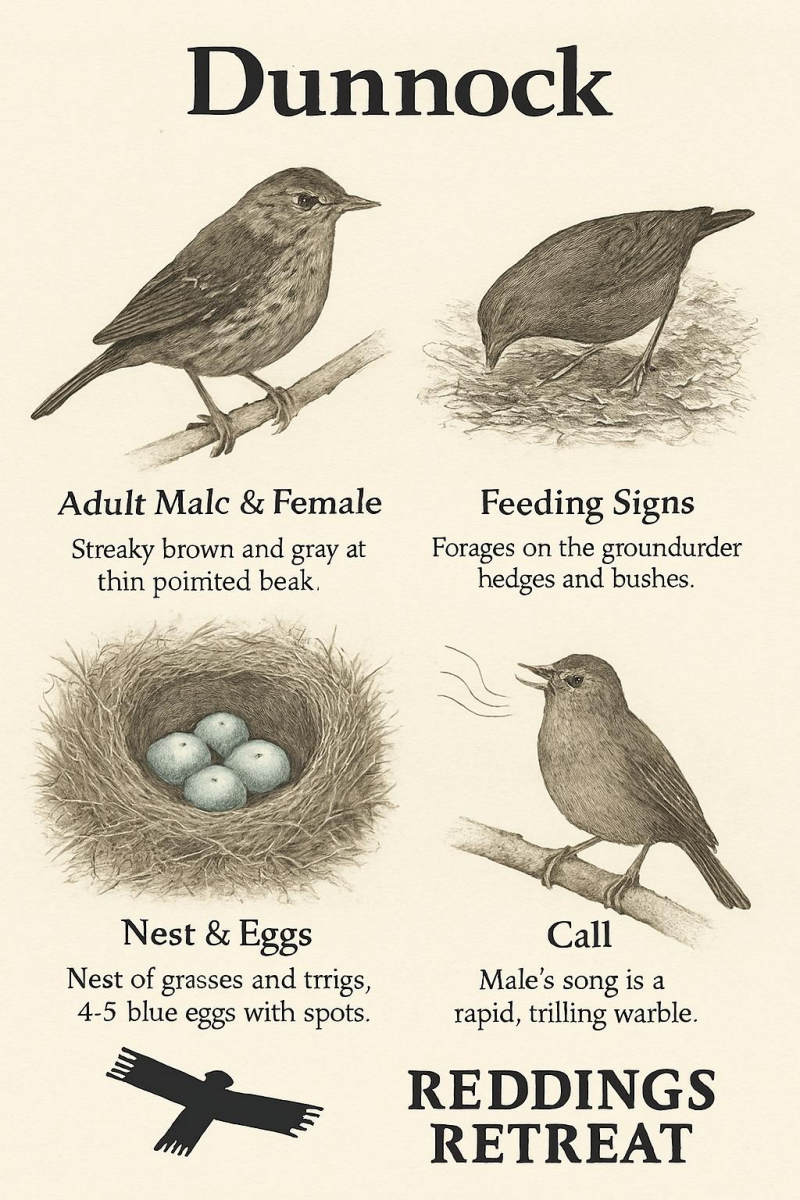
Dunnock (Prunella modularis / Llwyd y gwrych)
-
Description: Small, brown‑grey bird with fine streaking; slimmer than a sparrow with a thin bill.
-
Size: 13–14 cm.
-
Where it lives: Hedges, gardens, woodland edges, usually low to the ground.
-
Nest: Cup of moss, grass, and hair, hidden deep in shrubs or hedges.
-
Spotting Tip: Look for its shuffling, mouse‑like movements under hedges.
-
Photo Tip: Best photographed low down, crouching to hedge level; natural light brings out subtle plumage.
-
Rarity: Common — widespread but often overlooked.
-
Folklore: Sometimes called the “hedge sparrow,” though unrelated; associated with secrecy and modesty.
House Sparrow (Passer domesticus / Aderyn y to)
-
Description: Chunky, sociable bird; males have grey crowns and black bibs, females are plainer brown.
-
Size: 14–15 cm.
-
Where it lives: Around houses, farms, gardens — thrives near people.
-
Nest: Untidy domes of grass and feathers in roof spaces, holes, or dense shrubs.
-
Spotting Tip: Listen for their constant chirping in groups.
-
Photo Tip: Capture them in flocks on feeders or rooftops; group shots tell their social story.
-
Rarity: Declining / Conservation Concern — still common locally, but numbers have dropped nationally.
-
Folklore: Long associated with domestic life and community; a symbol of the “common folk.”
Meadow Pipit (Anthus pratensis / Corhedydd y waun)
-
Description: Slender, streaky brown bird with fine bill; often walks rather than hops.
-
Size: 14–15 cm.
-
Where it lives: Open grassland, meadows, upland pastures.
-
Nest: Grass‑lined cup on the ground, hidden among tussocks.
-
Spotting Tip: Watch for its parachuting display flight with a descending song.
-
Photo Tip: Best photographed in open fields; use a longer lens to avoid disturbing ground nests.
-
Rarity: Occasional — more frequent in upland areas, but still seen in the Wye Valley.
-
Folklore: Known as a “little brown job” by birders, but valued as a host for cuckoos in folklore and ecology.
Wagtails
Elegant, long‑tailed birds, often seen running across open ground or flicking along riverbanks. Their constant tail‑wagging makes them unmistakable.
Grey Wagtail (Motacilla cinerea / Siglen lwyd)
-
Description: Slender bird with a long tail, grey back, and bright yellow underparts.
-
Size: 18–19 cm.
-
Where it lives: Fast‑flowing rivers and streams, especially along the Wye.
-
Nest: Cup of moss, grass, and hair, tucked into crevices near water, bridges, or stone walls.
-
Spotting Tip: Look for its constant tail‑wagging as it darts along riverbanks.
-
Photo Tip: Best photographed near water with reflections; use a fast shutter to freeze its quick movements.
-
Rarity: Local Speciality — common along Wye Valley rivers but less widespread elsewhere.
-
Folklore: Associated with rivers and purity; in Welsh tradition, wagtails were thought to bring rain.
Pied Wagtail (Motacilla alba yarrellii / Siglen fraith)
-
Description: Black, white, and grey plumage with a constantly wagging tail.
-
Size: 18 cm.
-
Where it lives: Towns, farms, car parks, and open countryside — often close to people.
-
Nest: Cup of grass and hair in walls, roofs, or crevices.
-
Spotting Tip: Watch for their energetic tail‑wagging and darting runs across open ground.
-
Photo Tip: Urban backdrops (rooftops, cobbles) make for characterful shots; burst mode helps capture their quick dashes.
-
Rarity: Very Common — seen year‑round in villages and fields.
-
Folklore: Sometimes called “dish‑washer” in old dialects, linked with their tail‑wagging habit.
Tree climbers
Treecreeper (Certhia familiaris / Dringwr coed)
-
Description: Small, brown, streaky bird with a slender down‑curved bill and stiff tail feathers for support. Blends perfectly with tree bark.
-
Size: 12–13 cm.
-
Where it lives: Mature woodland, large gardens, and parkland with old trees.
-
Nest: Built behind loose bark or in tree crevices; made of twigs, moss, and bark strips, lined with feathers.
-
Spotting Tip: Look for its distinctive behaviour — spiralling up tree trunks before flying down to the base of another.
-
Photo Tip: Patience is key; pre‑focus on a tree trunk and wait for it to climb into view. Side‑lighting helps bring out its camouflage markings.
-
Rarity: Occasional — present year‑round but easily overlooked due to camouflage.
-
Folklore: Sometimes called the “little brown mouse of the woods,” symbolising persistence and humility.
Woodpeckers & Jays
Striking woodland birds, often heard before they’re seen. Their calls, drumming, and flashes of colour bring drama to the trees around Reddings Retreat.
Great Spotted Woodpecker (Dendrocopos major / Cnocell fraith fawr)
-
Description: Black and white with a red patch under the tail; males also have a red nape.
-
Size: 23 cm.
-
Where it lives: Woodland, parks, large gardens with mature trees.
-
Nest: Excavates holes in dead or soft wood, lined only with wood chips.
-
Spotting Tip: Listen for drumming on tree trunks in spring or their sharp “kick” call.
-
Photo Tip: Early morning is best; wait near dead trees for drumming displays.
-
Rarity: Common — regularly seen and heard in the Wye Valley.
-
Folklore: Traditionally a herald of rain in rural lore.
Green Woodpecker (Picus viridis / Cnocell werdd)
-
Description: Large, green‑backed woodpecker with a red crown and loud laughing call (“yaffle”).
-
Size: 30–32 cm.
-
Where it lives: Woodland edges, orchards, grassland with scattered trees.
-
Nest: Excavates holes in trees, lined with wood chips.
-
Spotting Tip: Often seen feeding on the ground, probing for ants.
-
Photo Tip: Capture them on lawns or meadows; their green plumage contrasts well with grass.
-
Rarity: Occasional — present but less numerous than Great Spotted.
-
Folklore: Known as the “yaffle,” linked with weather lore and sometimes thought to summon rain.
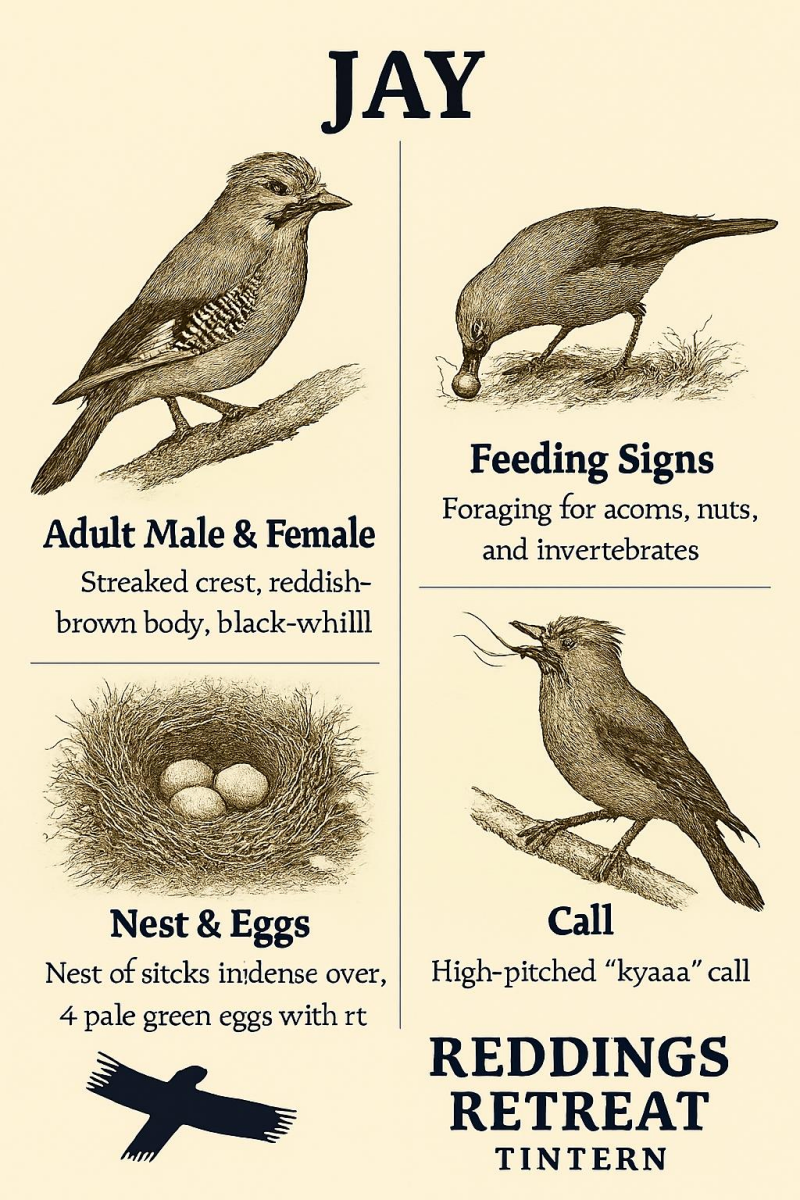
Jay (Garrulus glandarius / Sgrech y coed)
-
Description: Striking pinkish‑brown bird with a blue wing patch and loud screeching call.
-
Size: 34 cm.
-
Where it lives: Woodland, especially oak woods, but also large gardens.
-
Nest: Cup of twigs and roots, lined with softer material, usually in trees.
-
Spotting Tip: Often shy, but their harsh calls give them away.
-
Photo Tip: Autumn is best, when they carry acorns; look for flashes of blue in flight.
-
Rarity: Occasional — widespread but secretive.
-
Folklore: Associated with trickery and thievery, but also with foresight for their habit of caching acorns.
Corvids
Highly intelligent and social, corvids are among the most adaptable birds in Britain. Their calls, problem‑solving skills, and striking silhouettes make them unforgettable companions in the Wye Valley landscape.
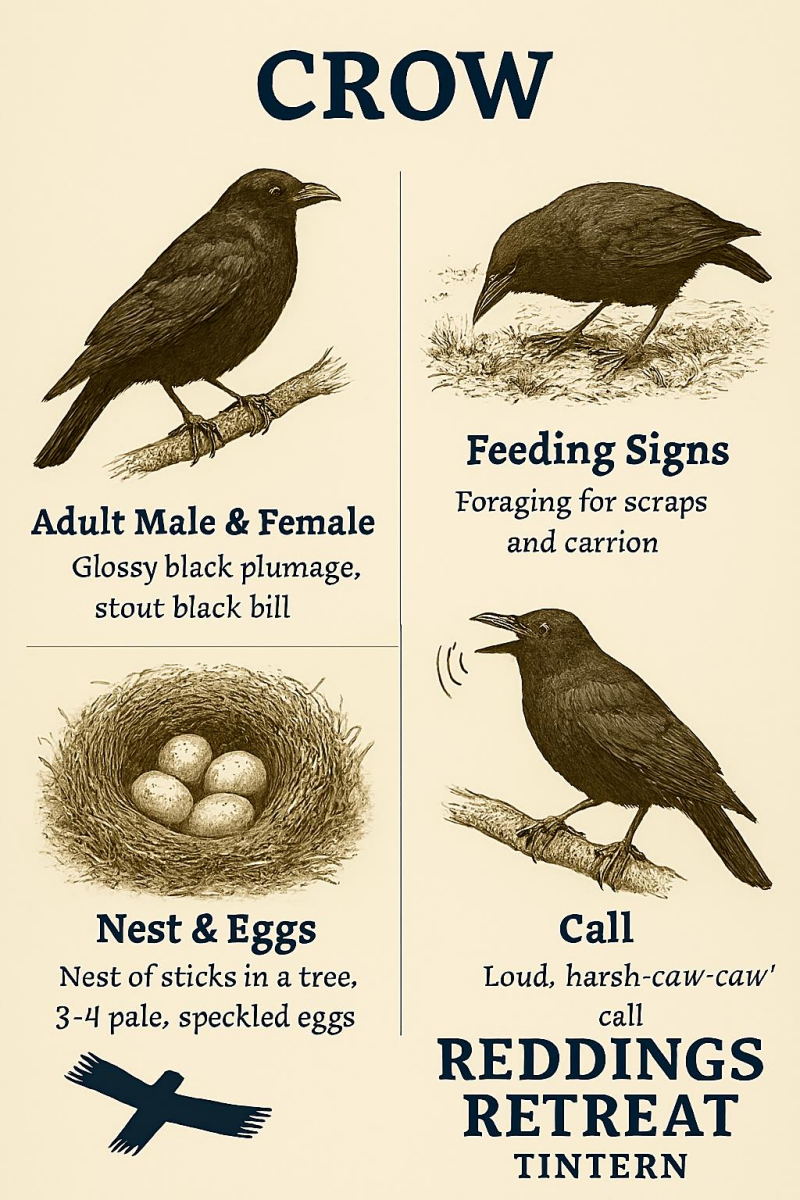
Carrion Crow (Corvus corone / Brân du)
-
Description: All‑black, intelligent, usually solitary or in pairs.
-
Size: 45–47 cm.
-
Where it lives: Farmland, woodland, towns, and gardens.
-
Nest: Large stick nest in trees or cliffs, lined with wool and hair.
-
Spotting Tip: Often alone, with a harsh “caw.”
-
Photo Tip: Side‑lighting brings out the crow’s glossy sheen.
-
Rarity: Common — widespread and seen year‑round.
-
Folklore: Associated with mystery and omens in Celtic and Norse traditions.
Common Raven (Corvus corax / Brân goesgoch)
-
Description: Huge, heavy‑billed, wedge‑tailed corvid with a deep croaking call.
-
Size: 60–65 cm.
-
Where it lives: Cliffs, uplands, wooded valleys.
-
Nest: Massive stick nests on cliffs or tall trees.
-
Spotting Tip: Look for soaring flight and acrobatic rolls.
-
Photo Tip: Capture in flight against the sky to show the wedge‑shaped tail.
-
Rarity: Local Speciality — regular in the Wye Valley but not everywhere.
-
Folklore: Linked with prophecy, battle, and the god Bran in Welsh mythology.
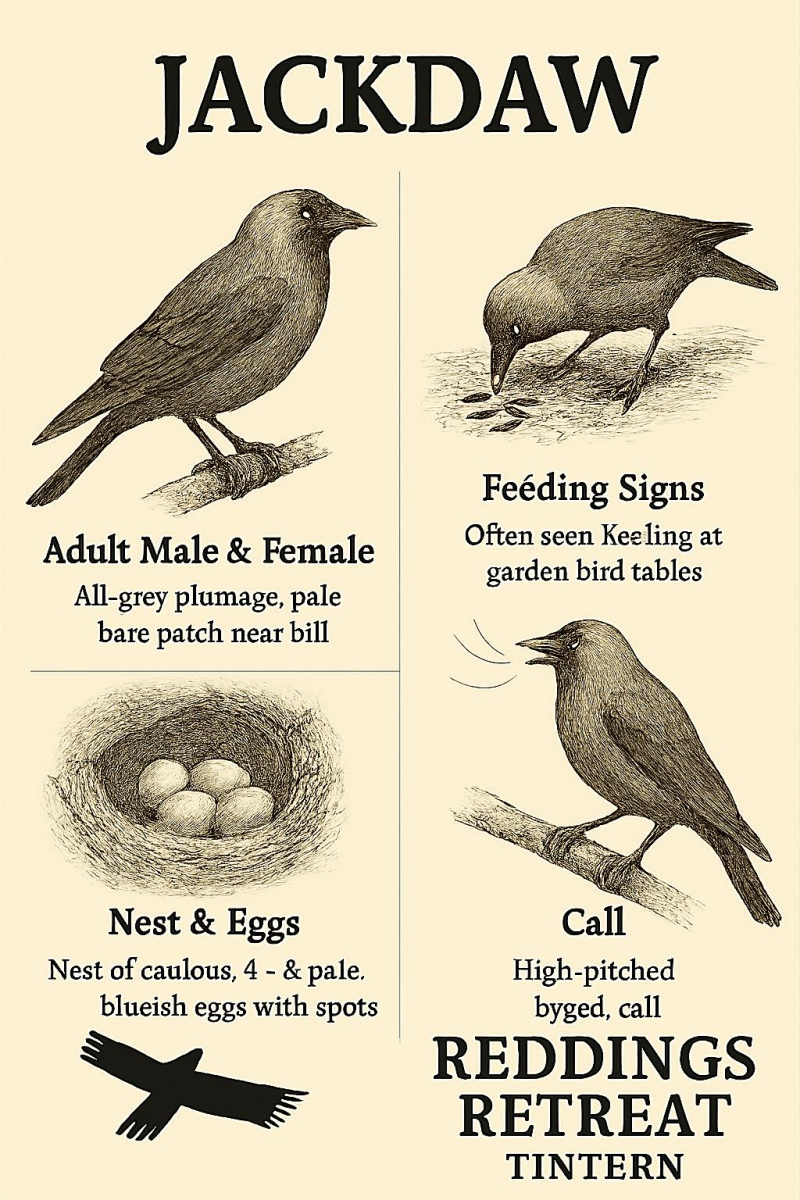
Jackdaw (Corvus monedula / Jac‑y‑do)
-
Description: Small, grey‑naped corvid with pale eyes.
-
Size: 34 cm.
-
Where it lives: Villages, chimneys, cliffs, and farmland.
-
Nest: Holes in buildings, trees, or cliffs, filled with sticks.
-
Spotting Tip: Sociable, often in noisy flocks.
-
Photo Tip: Urban rooftops and chimneys make characterful backdrops.
-
Rarity: Very Common — abundant in towns and countryside.
-
Folklore: Associated with mischief and chatter; sometimes seen as a bringer of luck.
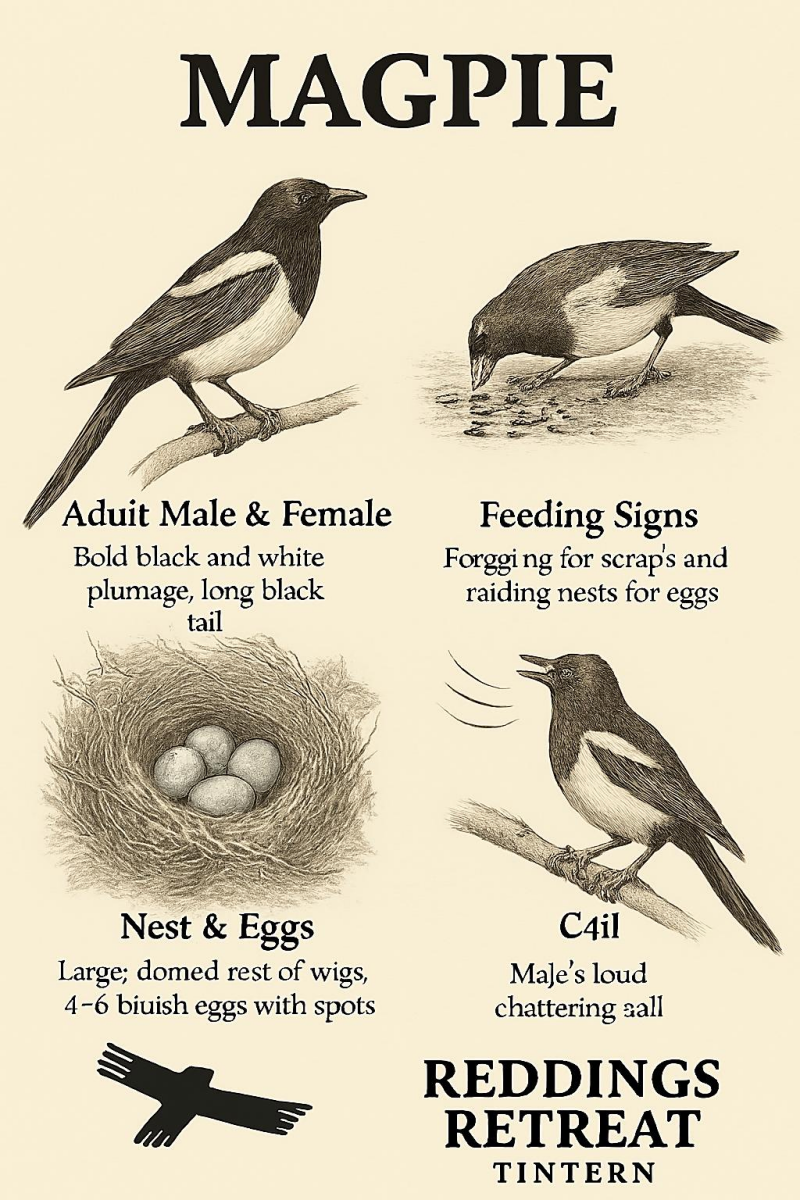
Magpie (Pica pica / Pioden)
-
Description: Black‑and‑white plumage with iridescent green‑blue sheen.
-
Size: 44–46 cm.
-
Where it lives: Farmland, gardens, woodland edges.
-
Nest: Large domed stick nest in trees.
-
Spotting Tip: Bold and conspicuous, often in pairs.
-
Photo Tip: Sunlight highlights their iridescent feathers.
-
Rarity: Common — widespread across the UK.
-
Folklore: Steeped in superstition — “One for sorrow, two for joy…”
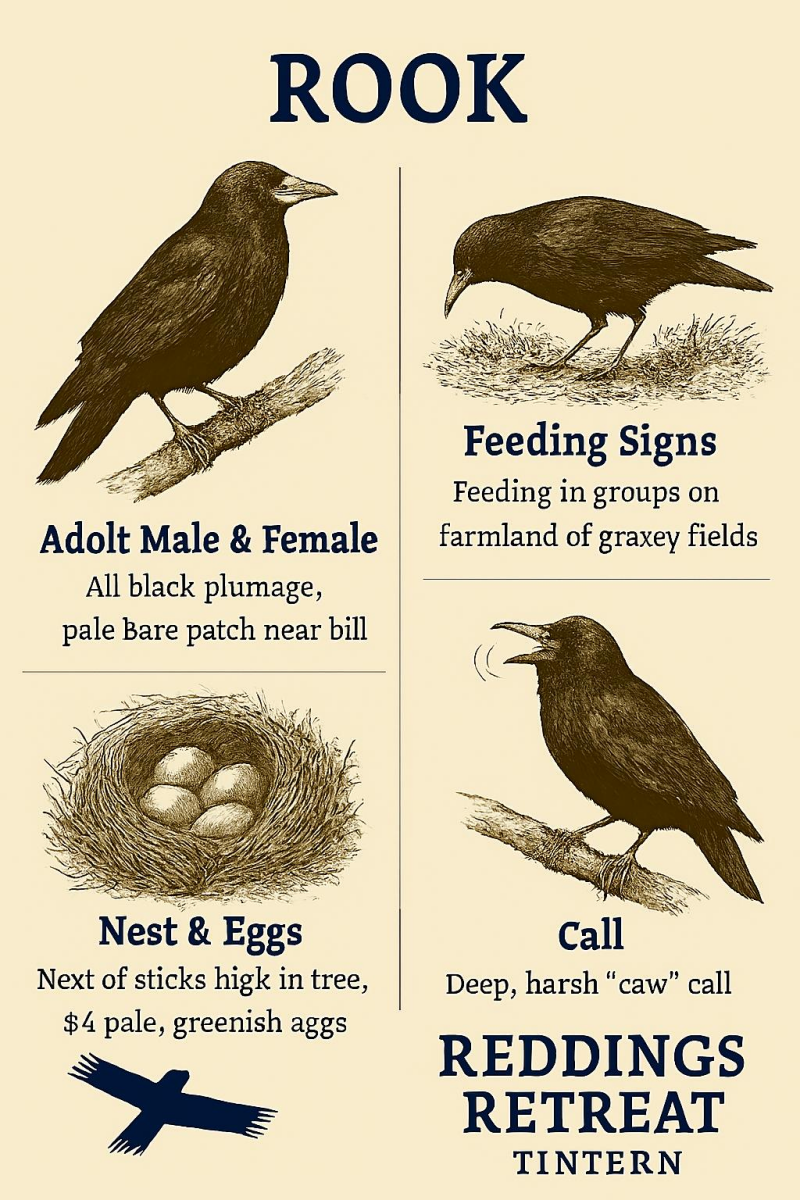
Rook (Corvus frugilegus / Ydfran)
-
Description: Black with bare greyish bill base; sociable and often in groups.
-
Size: 45 cm.
-
Where it lives: Farmland, villages, and rookery trees.
-
Nest: Stick nests in colonies (“rookeries”).
-
Spotting Tip: Look for groups feeding in fields.
-
Photo Tip: Capture rookery trees in spring for atmospheric shots.
-
Rarity: Common — especially in rural areas.
-
Folklore: Associated with farmland and rural life; their rookeries were once seen as omens of prosperity.
Pigeons & Doves
Familiar and widespread, these birds are often overlooked but form part of the daily soundtrack of the countryside and towns alike.
Rock Dove (Columba livia / Colomen graig)
-
Description: The wild ancestor of domestic pigeons; grey with two dark wing bars.
-
Size: 32–34 cm.
-
Where it lives: Cliffs and coastal areas; feral forms in towns.
-
Nest: Simple platform of sticks or grass on ledges.
-
Spotting Tip: Look for flocks in towns or rocky outcrops.
-
Photo Tip: Capture wing bars in flight.
-
Rarity: Occasional — true wild birds rare, feral forms common.
-
Folklore: Symbol of endurance and adaptability.
Stock Dove (Columba oenas / Colomen lwyd)
-
Description: Smaller than Wood Pigeon, with uniform grey plumage and dark eyes.
-
Size: 30–33 cm.
-
Where it lives: Woodland edges, farmland, parkland.
-
Nest: Tree holes or old buildings, lined with twigs.
-
Spotting Tip: Often seen in pairs, quieter than Wood Pigeons.
-
Photo Tip: Best in soft light to show subtle grey tones.
-
Rarity: Occasional — less common than Wood Pigeon.
-
Folklore: Associated with peace and gentleness.
Wood Pigeon (Columba palumbus / Colomen coed)
-
Description: Large pigeon with white neck patch and wing bars.
-
Size: 40–42 cm.
-
Where it lives: Gardens, farmland, woodland.
-
Nest: Flimsy stick platform in trees.
-
Spotting Tip: Loud “coo‑coo” call; often seen in flocks.
-
Photo Tip: Capture in flight to show white wing flashes.
-
Rarity: Very Common — one of the UK’s most abundant birds.
-
Folklore: Linked with abundance and rural life.
Game Birds
Introduced species that add colour and drama to farmland and woodland edges.
Guinea Fowl (Numida meleagris / Iar Gini)
-
Description: Helmeted bird with spotted plumage, often noisy.
-
Size: 53–63 cm.
-
Where it lives: Farmland, smallholdings, sometimes feral.
-
Nest: Ground scrape lined with grass.
-
Spotting Tip: Listen for loud, chattering calls.
-
Photo Tip: Best in groups, showing spotted plumage.
-
Rarity: Occasional — usually from local releases.
-
Folklore: Associated with domesticity and protection.
Pheasant (Phasianus colchicus / Ffesant)
-
Description: Males brightly coloured with long tails; females mottled brown.
-
Size: 60–90 cm.
-
Where it lives: Farmland, woodland edges.
-
Nest: Ground scrape lined with grass.
-
Spotting Tip: Explodes noisily from cover when disturbed.
-
Photo Tip: Early morning light shows iridescence.
-
Rarity: Common — due to widespread releases.
-
Folklore: Symbol of rural abundance.
Red‑legged Partridge (Alectoris rufa / Petrisen goesgoch)
-
Description: Plump, grey‑brown bird with red legs and striking face pattern.
-
Size: 32–34 cm.
-
Where it lives: Farmland, grassland, woodland edges.
-
Nest: Ground scrape lined with vegetation.
-
Spotting Tip: Runs rather than flies when disturbed.
-
Photo Tip: Capture in open fields or stubble.
-
Rarity: Occasional — introduced and locally common.
-
Folklore: Associated with hunting traditions.
Raptors
Birds of prey bring drama to the skies above the Wye Valley, from hovering kestrels to soaring red kites.
Buzzard (Buteo buteo / Bwncath)
-
Description: Large, broad‑winged raptor, brown with pale underparts.
-
Size: 55 cm; wingspan up to 120 cm.
-
Where it lives: Woodland, farmland, valleys.
-
Nest: Stick platform in tall trees.
-
Spotting Tip: Circles high with a mewing call.
-
Photo Tip: Capture soaring against clouds for scale.
-
Rarity: Common — widespread and often seen.
-
Folklore: Symbol of wild freedom.
Kestrel (Falco tinnunculus / Cudyll coch)
-
Description: Slim falcon, chestnut back, hovers with tail fanned.
-
Size: 32–35 cm.
-
Where it lives: Farmland, grassland, roadside verges.
-
Nest: Old crow nests, ledges, or buildings.
-
Spotting Tip: Look for hovering over fields.
-
Photo Tip: Best in hover with blurred wings.
-
Rarity: Occasional — less common than in the past.
-
Folklore: Linked with patience and hunting skill.
Peregrine Falcon (Falco peregrinus / Hebog tramor)
-
Description: Powerful falcon, blue‑grey above, barred below.
-
Size: 40–50 cm; wingspan 100 cm.
-
Where it lives: Cliff ledges, quarries, tall buildings.
-
Nest: Scrape on cliff ledges or tall structures.
-
Spotting Tip: Fast stoops after pigeons.
-
Photo Tip: Best at known nest cliffs or in flight against sky.
-
Rarity: Local Speciality — breeds in the Wye Valley.
-
Folklore: Symbol of nobility and falconry.
Red Kite (Milvus milvus / Barcud coch)
-
Description: Large raptor with reddish body and forked tail.
-
Size: Wingspan up to 180 cm.
-
Where it lives: Valleys, farmland, woodland edges.
-
Nest: Large stick nests in tall trees, reused yearly.
-
Spotting Tip: Forked tail and graceful gliding flight.
-
Photo Tip: Best against blue sky or valley backdrop.
-
Rarity: Local Speciality — conservation success, common in Wales.
-
Folklore: Revered in medieval times; symbol of freedom.
Sparrowhawk (Accipiter nisus / Gwalch glas)
-
Description: Small hawk; males bluish, females brown, both with barred chest.
-
Size: 28–38 cm.
-
Where it lives: Woodland, gardens, farmland.
-
Nest: Stick nests in woodland.
-
Spotting Tip: Dashes through gardens after small birds.
-
Photo Tip: Hard to catch — garden feeders sometimes yield shots.
-
Rarity: Occasional — present but elusive.
-
Folklore: Associated with stealth and suddenness.
Water & Wetland Birds
The Wye Valley’s rivers, ponds, and wetlands provide a home for graceful swans, dabbling ducks, and patient herons.
Canada Goose (Branta canadensis / Gwydd Canada)
-
Description: Large goose with black head and neck, white chinstrap.
-
Size: 90–100 cm.
-
Where it lives: Rivers, lakes, fields.
-
Nest: Ground nests near water, lined with down.
-
Spotting Tip: Often in noisy flocks.
-
Photo Tip: Capture reflections on calm water.
-
Rarity: Common — widespread.
-
Folklore: Introduced species, now part of the landscape.
Grey Heron (Ardea cinerea / Creyr glas)
-
Description: Tall, grey bird with long neck and dagger bill.
-
Size: 90–98 cm.
-
Where it lives: Rivers, lakes, wetlands.
-
Nest: Stick platforms in colonies (“heronries”).
-
Spotting Tip: Stands motionless fishing at river edges.
-
Photo Tip: Best in profile with reflection.
-
Rarity: Common — regular along the Wye.
-
Folklore: Associated with patience and stillness.
Mallard (Anas platyrhynchos / Hwyaden wyllt)
-
Description: Males with green head, females mottled brown.
-
Size: 50–65 cm.
-
Where it lives: Ponds, rivers, lakes.
-
Nest: Ground nests hidden in vegetation.
-
Spotting Tip: Dabbling in shallow water.
-
Photo Tip: Capture drakes in spring plumage.
-
Rarity: Very Common — the UK’s most familiar duck.
-
Folklore: Symbol of adaptability.
Moorhen (Gallinula chloropus / Iar ddŵr)
-
Description: Dark plumage with red bill and yellow tip, white undertail flashes.
-
Size: 30–35 cm.
-
Where it lives: Ponds, rivers, wetlands.
-
Nest: Floating or bank nests of reeds.
-
Spotting Tip: Skulks in vegetation, flicking white tail.
-
Photo Tip: Low angle by water’s edge.
-
Rarity: Common — widespread.
-
Folklore: Linked with water spirits in folklore.
Mute Swan (Cygnus olor / Alarch ddomestig)
-
Description: Large white swan with orange bill and black knob.
-
Size: 140–160 cm; wingspan up to 240 cm.
-
Where it lives: Rivers, lakes, ponds.
-
Nest: Large reed mounds by riverbanks.
-
Spotting Tip: Graceful gliding on water.
-
Photo Tip: Best in golden light for reflections.
-
Rarity: Common — iconic on the Wye.
-
Folklore: Associated with royalty, love, and transformation.
🌿 Final Note / Share Your Spotting
Every sighting adds to the story of Reddings Retreat. If you capture a special moment — whether it’s a robin feeding chicks or a buzzard circling overhead — we’d love to hear about it.
📩 Share your spotting with Charlotte directly, or tag us on social media. With your permission, we may feature your photo or story in future updates of our guides.
📚 Further Resources
For quick help identifying calls and photos, try the free Merlin Bird ID App. It’s a great way to log your sightings and build your own record of birds spotted at Reddings Retreat.
🔗 Navigation
← Back to Bird ID Index | Core Residents (you are here) | Seasonal Visitors | Special Guests →
Create Your Own Website With Webador